
Feb 202021
 

Pawns are like mushrooms. Sometimes they can be a tasty treat, other times they can be poisonous. Telling the difference isn’t always easy. Photo: Alan Cleaver

From time to time we have a little fun with Pete Leonard about his principled approach to accepting pawn sacrifices. As he mentioned in his comment to our last post, his inclination is always to accept whatever is on offer and “put the money in the bank/your pocket”. Absolutely nothing wrong with that approach and Pete is a strong enough player to know (at least some of the time!) when it’s not a good idea to take the material.

Pete was at it again last Tuesday as round 2 of the 4NCL Online Spring Congress took place. This time though there was an interesting counter balance to his success in that Dave Shapland’s opponent went pawn grabbing and got himself into the hottest water as a result.

But let’s start with Pete. Having started the tournament out with a draw he was doubtless keen to get a win under his belt and, with the White pieces and a lower rated opponent at hand, he duly bagged the full point. His opponent played the Scandinavian and ventured a dubious gambit on move 3. Pete ate the ‘mushroom’ and seemed to be duly nourished as a result. On move 16 Pete’s opponent generously offered him another tasty morsel but he got very little in exchange  for it – managing only to exchange off one of Pete’s bishop’s for his knight. Pete saw no reason not to have another bite and quote right too. By move 20 he had a stable two pawn advantage and a passed -a pawn of his own to boot! The rest was relatively straight forward and Pete converted comfortably.

Dave on the other hand had won his first round game and was therefore expecting to face a stronger opponent than in round 1. Indeed, his opponent, Steve Wylie, did play well early on in the game and responded sensibly to Dave’s provocative approach to the London System which involved him playing 1d4 c5!? and then after 2.c3 venturing 2…Qc7?! which must be dubious but prevented White from playing the move he wants to play 3.Bf4. The main problem for the Steve was that he played too slowly. This meant that, when the position sharpened on move 22, he didn’t have as long to calculate and assess variations as he might have liked. At that point in the game with 22…Nc5?! Dave offered his opponent a choice of pawns to grab on a7 and e7. Steve grabbed the e7 pawn with his rook and then, when Dave took his d-pawn he speculated on maintaining his material advantage with 24.Rxa7?? But this time the pawn was poisoned. With White’s rook and queen away on the a-file, Dave had time mount an attack on the enemy king. When Steve then grabbed a second hot pawn with 26.Rxd6? it was pretty much all over and Dave’s attack broke through.

Also playing in the ‘Major’ section, for players rated under 2000,  was John Allan. He too had won his first round game and was looking to advance to 2/2. The pawn grabbing theme continued here when John responded to his opponent’s Catalan Variation by accepting the gambit pawn on c4 and holding onto it. White never really seemed to get anything much for the pawn although the variation is perfectly reputable. By move 16 John had picked up a second pawn, this time through a blunder rather than a sacrifice, and he calmly proceeded to mop up, never giving his opponent any counterplay and winning more and more material.

So much for the three players in the Major. How did Ollie Hill get on in his second round game in the Open section. Readers may remember that, last time out, unrated Ollie snatched a famous win in his first game in a competition of this kind. Naturally, his ‘reward’ was a draw against a much stronger opponent in round 2. Indeed Anastasis Kafetzopoulos, with a rating of 2131 proved to be a completely different proposition. Ollie played the Alapin Sicilian with 2.c3 but, sadly, he fell into a tactic early on in the game that cost him a piece and, after that, his opponent clinically put him to the sword. Still, there are five rounds left and Ollie will come up against opponents that he can expect to do well against later in the competition.

Below are all of the games mentioned above with some engine annotations from the Lichess house engine – Stockfish.

Feb 102021
 

Both our Hebden Bridge teams drove through the opposition last night to notch up their second wins of the competition. Photo: Dermot O’Halloran

Last night saw the second round of action in the 4NCL Online League with both Hebden Bridge teams taking part in Division 7 matches.

Having had relatively straightforward assignments last time out, both sides were expecting sterner tests in round 2 and, despite the fact that between them they only dropped half a point, that should not disguise the fact that the matches were much more competitive. The first team in particular were pushed hard by a handy Aberystwyth University 1 side.

Hebden Bridge 1 were without the services of Greg Eagleton, who played board 2 last time out, but in came Pete Leonard on board 4 whilst Andrew Clarkson and Dave Shapland both moved up a board.

Meanwhile, Hebden Bridge 2 faced a Muswell Hill Juniors team that looked very green on paper but it’s always dangerous to assume that a junior’s rating has kept pace with their ability. All of them sported much higher Lichess ratings than they had ECF Online ratings.

However, it was Hebden Bridge 2 who started the night with two quick wins. On board 4, Terry Sullivan was first to strike with the Back pieces. He played sensibly against his young opponent, first securing the bishop pair, then targeting a pawn weakness to win material and finally, when his opponent tried for counter play he took over in the centre of the board and set up a simple mating pattern that his adversary overlooked.

Shortly afterwards Josh Blinkhorn made it 2-0 to the second team when he also delivered checkmate by taking advantage of his opponent having not castled. John Allan then made it 3-0 against another opponent who never got castled. Note that John should have been playing Black but his opponent issued the challenge on Lichess incorrectly and, despite John trying to get them game aborted, they continued. This error was flagged with the arbiters afterwards and there was a chance that the game would be scored 0-0 but in the end the result stood.

Meanwhile, the first team were having a more challenging time of it against Aberystwyth University who certainly played in enterprising fashion. For example Pete Leonard’s opponent on board 4, Kieran Rafferty, played 2…f5 against his Bishop’s Opening – evidently this is called the Calabrese Gambit! Being the pawn-grabber extraordinaire that he is, Pete played it like a King’s Gambit Accepted in reverse and this give him a stable advantage with an extra pawn and decent development. By move 25, Pete had two extra pawns and the queens were off. Black’s only compensation was that he had a bishop pair against Pete’s pair of knights. However, that proved to be nothing like enough and Pete converted by pushing his connected passed e and f pawns down his opponent’s throat.

The next to win was Phil Cook on board 1. We’re used to seeing Phil play solid, positional chess under pinned by an sharp tactical sense that knows when his opponent has slipped to take full advantage. On this occasion however he was the one going a little bit wild as, playing a reversed Sicilian against the English Opening he decided to expanded rapidly on the king’s side with h5 and then g5 before he had gotten his king to safety. This looked risky but he was able to get away with it because his opponent had blocked the centre by playing e4 as early as move 4. According to Stockfish the game was littered with inaccuracies which is hardly surprising given the complexity of the position, however, it was Phil who came out on top in the melee driving his opponent’s king into the centre of the board. White had no coordination and resigned as soon as Phil made a tactical break through.

Andrew Clarkson sealed the won for the first team by winning his game on board 2. This game was a Four Knights Sicilian and, even though Andrew won the exchange, his opponent seemed to have sufficient compensation to hold on. At one point Andrew event thought he might be worse (see his game notes in the viewer below). However, once the players had transposed into an endgame where Andrew had the exchange for a pawn, his superior endgame technique won the day and Andrew got over the line to make it 3-0.

The last two games to finish in each match were tense affairs. On board 3 for the first team, Dave Shapland had to weather a very dangerous looking attack on the Black side of a Sicilian Dragon. However, Dave was confident that his opponent had launched his assault prematurely and, taking a leaf out of Mr Leonard’s book simply took everything that was offered to him. First one pawn, then another and finally the exchange. The critical moment came when Dave found 16…Rc5! which helped him to defend along the fifth rank. His opponent missed one fleeting chance to equalise and after that Dave’s counter attack was unstoppable even if he did miss a simple checkmate that would have crowned the performance nicely.

On board 1 for the second team, Dave Wedge was up against a tough opponent in Stanley Badacsonyi who certainly outperformed his rating by some margin. This was perhaps the most accurately played of all the games last night. There were comparatively few errors and, although Dave at one point achieved an advantage, he was able to hold on to it and got into trouble on the clock. Eventually the players agreed a draw  with fours pawns each and opposite coloured bishops left on the board.

So, another 4-0 win for the first team and a 3.5-0.5 win for the second team. The third round in two week’s time will surely see at least one of the paired with a side that could be stronger than them. It should start to get really interesting from here on in.

All the games from last night can be found in the game viewer below. In most cases the annotation is from Lichess’s house engine – Stockfish, but Andrew Clarkson and Dave Shapland have provided some annotation of their own. You can find instructions for using the viewer just down below it at the end of the post.

Instructions for using the PGN Viewer

For the benefit of those who are uninitiated (or simply can’t remember as it’s been so long!) the game viewer above contains all eight games played on Tuesday night. It will automatically scroll through all of them one after the other unless you tell it to stop by clicking on the ‘=’ button below the board. To select the game you wish to view click on the ‘…’ symbol in the white box above the board. This will reveal a drop down menu for you to choose from and when you select your game will appear. You can navigate forwards and backwards using the arrow buttons beneath the board or click on the moves in the text box on the right. Most of the annotations in these games have been generated by Lichess’ in house engine which creates auto-analysis for every game played (one of the tools they use to track down and punish cheats!) and are therefore part of the download when you export games from Lichess to your own chess engine or database.

Feb 052021
 

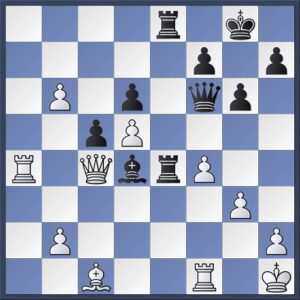
Gordon vs. Hill. White has just played 30.g3. How should Black proceed here? Answer in the report below.

As mentioned in last week’s post, online chess competitions are booming to cover the ongoing gap left by the absence of over the board chess. Last Tuesday the 4NCL’s (Four Nations Chess League) third online season for their team competition began. This week saw their individual competition kick off. This is a seven round Swiss System played every other Tuesday between the 2nd of February and the 27th of April. There are four sections: an Open which has 63 participants, the Major (for players rated under 2000) which has 47 participants, the Intermediate (U1700) with 68 participants and a Minor (U1400 and beginners) with 39 participants. With a time limit of 45 minutes for all moves plus 15 seconds per move this (like the team competition) is the closest thing we’re going to get to Classical chess time controls until we can get back to playing face-to-face.

For the second edition of this individual competition (which took place between September and December last year) your editor was the only member of the club to take part. For the record I scored a fairly miserable 2.5/7 in the Open section. This time there are four players affiliated with the club involved across the top two sections.

Let’s start with one of our latest members. Ollie Hill only joined our Lichess community last week and has no English Chess Federation rating but he can clearly play a bit as he bravely decided to have a go in the Open Section. He’s the only unrated player in the section and was rightly anxious about getting hammered although he felt the experience would be ‘instructional’. As it happened, Ollie managed to come out on top after a complicated and messy struggle against the 31st seed in his section, Sean Gordon, who’s rating is 1909. Playing a Benoni, Ollie missed a couple of chances to exchange the frequently bad light squared bishop and seemed to be hanging on early in the middle game. However, with both players dropping in the odd inaccuracy, the game remained balanced.

The critical moment arrived in the diagram position given above. Ollie (playing Black) has a winning position here after his opponents previous move 30.g3?? which is a blunder. Ollie played the very natural looking response 30…Bxb2?? which appears to be winning him a pawn but in fact transforms the position from being a Black win to being a White win! His opponent found the correct idea initially by giving up his queen for two rooks with 31.Qxe4 Rxe4 32.Rxe4 but after 32…Bxc1 he missed the winning continuation which is not to recapture the bishop on c1 (as he did in the game and went on to lose) but instead to play 33.Re8+! Kg7 34.b7 when his b-pawn cannot be stopped and White will simply need to figure out how to walk out of some spite checks.

Instead of all this, Ollie needed to find 30…Qf5! This clever creeping move maintains the threat of Bxb2 but also threatens to get the queen to e4 or h3 with mating threats. For example: 30…Qf5! 31.Qc2 Re1! 32.Qxf5 Rxf1+ 33.Kg2 Rf2+ and then gxf5 wins Black a rook. Or 30…Qf5 31.Qb3 Qh3! and White must give up everything just to delay 32…Re2 and mate to follow on h2 (which explains why 30.g3?? was a blunder). A very complicated position but highly instructive.

After this adventure, Ollie went on to win with his queen against White’s two rooks as he was able to pick up the White passed b-pawn and then had too many targets to attack. Despite being low on time, Ollie converted nervelessly. Congratulations to him on a fine achievement in his first competitive online game!

Elsewhere, in the Major section, Dave Shapland, Pete Leonard and John Allan were all hoping to win their round 1 games against lower rated opposition. Dave and John did indeed manage to do this fairly easily as they had White and their opponents made critical blunders that led to sudden defeats. Pete’s opponent however proved more resilient and managed to hold Pete to a draw with a knight and pawns versus bishop and pawns ending. Pete will feel he missed chances to pick up a full point. 22…Bh3 instead of Bd7 looks like a significant opportunity. But, in a competition over 7 rounds, a draw, even against a lower ranked player, in round 1 could enable him to score well in subsequent rounds as he may be able to avoid the highest rated players in the section for the time being. Let’s see if his ‘Swiss Gambit’ will turn out well for him in the long run.

All four games by the Hebden Bridge contingent are given in the game viewer below.

Instructions for using the PGN Viewer

For the benefit of those who are uninitiated (or simply can’t remember as it’s been so long!) the game viewer above contains all four games played on Tuesday night. It will automatically scroll through all of them one after the other unless you tell it to stop by clicking on the ‘=’ button below the board. To select the game you wish to view click on the ‘…’ symbol in the white box above the board. This will reveal a drop down menu for you to choose from and when you select your game will appear. You can navigate forwards and backwards using the arrow buttons beneath the board or click on the moves in the text box on the right. Most of the annotations in these games have been generated by Lichess’ in house engine which creates auto-analysis for every game played (one of the tools they use to track down and punish cheats!) and are therefore part of the download when you export games from Lichess to your own chess engine or database.